



Traditional sourcing expands your reach, while AI candidate search helps you rediscover hidden talent in your existing pool. Here is a look at how the two compare and why recruiting teams need both.
AI Candidate Search vs. Traditional Sourcing
AI candidate search and traditional sourcing answer different questions, which is why most successful recruiting teams end up using both. Traditional sourcing goes out to find talent across the open market, while AI candidate search works through the candidates a company already has.
This article compares the two approaches, exploring where each one is faster, how they overlap, and why a recruiter’s judgment remains essential.
What Each Approach Actually Does
Traditional sourcing is recruiter-led. A sourcer builds searches by hand—usually with Boolean strings and filters on professional networks and job boards—and adds referrals, talent communities, and direct outreach to the mix. Its main strength is reach: it can surface talent who have never applied to the company and who may not be looking for a job at all.
AI candidate search starts from a different place because the candidates are already in the company’s own pool. For example, Coensio’s AI Candidate Search connects to a company's existing talent pool through an ATS integration and analyzes the candidates it finds there. (A company that uses Coensio without an ATS connection can run the same search over the candidates stored in its own Coensio database).
Instead of using complex Boolean strings, the recruiter describes the profile they are looking for in their own words. This can be a detailed list of requirements or a short brief, such as "software developers with at least three years of experience." Every candidate in the pool is then scored against those criteria and ranked based on past experience, education, skills, seniority level, and other CV details.
If a candidate has previously taken an assessment for a relevant role, that result appears in their candidate analysis. Having taken an assessment doesn’t artificially boost their ranking on its own; rather, it provides valuable added context for the recruiter during the review process.
Where Each Approach Excels
Neither approach is objectively better across the board, because each one wins on the task it was built for.
Pool Size Sets the Ceiling
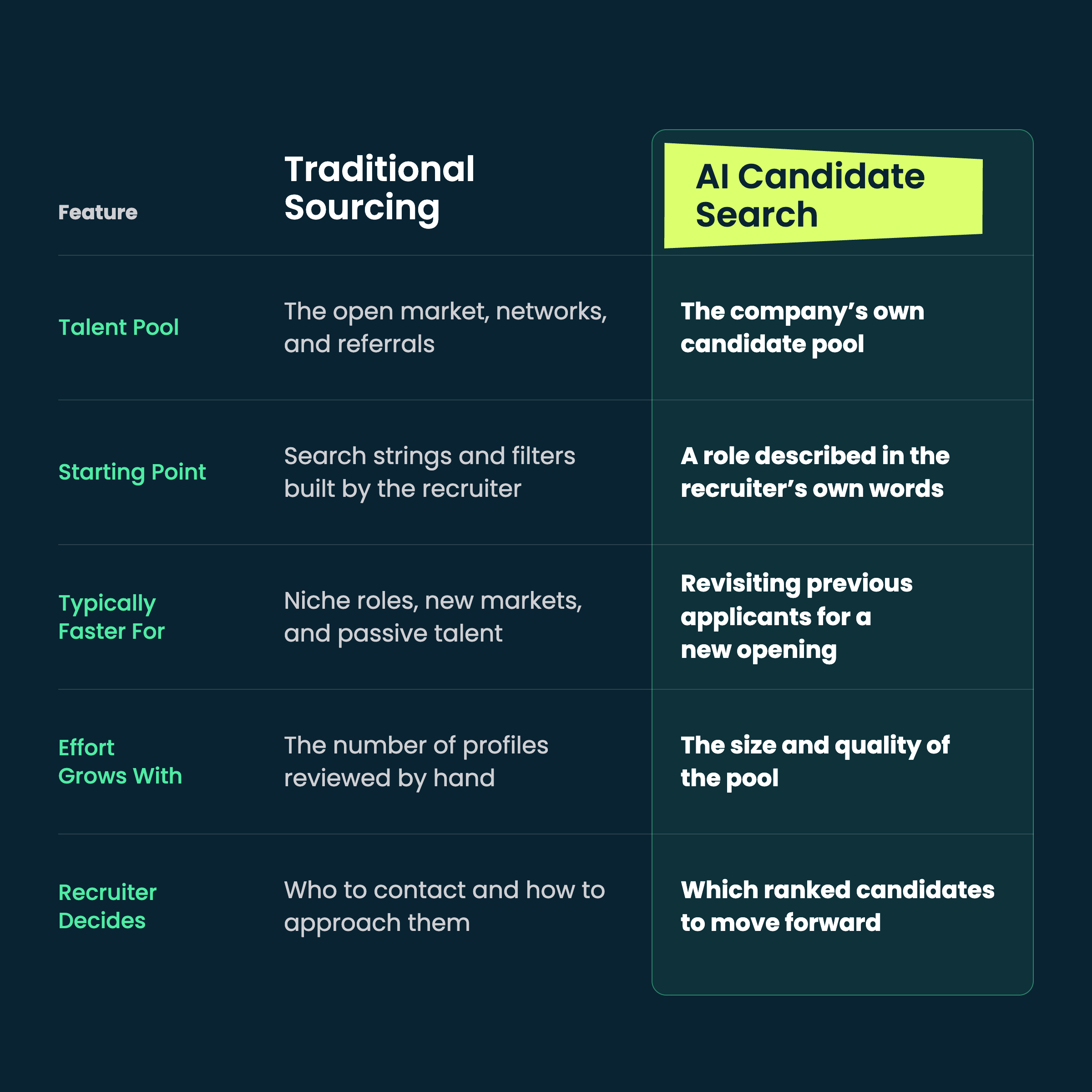
There is no public, globally shared candidate pool behind AI candidate search. It searches only the candidates a company already has. Therefore, the size and quality of that specific pool shape the final result more than anything else. A company with years of past applicants has a rich database to work with, while a company with a small pool will see fewer strong matches, regardless of how advanced the AI matching is.
This is exactly where traditional sourcing keeps its place. When a role requires someone the company has never interacted with before, the answer lies outside the existing pool, and only active sourcing can reach them.
Where Recruiter Judgment Stays Essential
A ranked list narrows the field, but it doesn’t make the hiring decision. A recruiter still needs to evaluate the top of the list against the nuanced realities of the role, such as team context, timing, and what the hiring manager actually needs. Outreach also remains a distinctly human task; a candidate's motivation, availability, and communication style cannot be read from a CV score.
The same applies in the other direction. A sourcer who finds a promising profile on a professional network still has to judge whether it truly fits the role. That judgment works the same way whether AI is in the workflow or not. The ultimate goal of AI search isn't to replace the recruiter, but to allow the same team to cover more ground while keeping their attention focused on the high-value human interactions that require it.
Using Both Together
In practice, a common modern recruiting workflow looks like this:
- A new opening comes in, and the recruiter first runs an AI candidate search to see if any candidates in the company’s existing pool already match the role.
- Candidates with a relevant past assessment are surfaced with that result in their analysis, allowing the first review to start with deeper context.
- If the internal pool doesn’t produce the right fit, the sourcer takes over with active outreach in the wider market.
- Once a newly sourced candidate enters the ATS, they become part of the company’s own pool, meaning future AI searches can seamlessly include them as well.
Seen this way, the two approaches feed each other: traditional sourcing grows the talent pool, and AI candidate search ensures a company actually makes the best use of it.
Choosing Where to Start
If your talent pool is large and rarely revisited, AI candidate search is the most practical first step because it puts forgotten existing talent back in front of your team. If your roles are highly niche or your internal pool is still small, traditional sourcing will continue to carry most of the workload. Most teams sit somewhere between the two, and the ideal mix shifts dynamically as the company's candidate pool grows.


