

Discover how AI candidate search uses natural language to uncover hidden talent in your existing database, and learn how semantic matching compares to traditional Boolean search.
AI candidate search lets a recruiter describe an open role the way they would describe it to a colleague, then returns a ranked list of matching candidates from a database along with an explanation of why each profile surfaced. Instead of building a keyword string and hoping candidates used the same words on their CVs, you describe the requirement and the system interprets it as a set of criteria.
The term has become common enough that it now covers two fairly different products. Understanding which one you are looking at matters more than any feature comparison, so that is where this article starts.
Two Different Things Called "AI Candidate Search"
Some tools search external profile data: public professional profiles, scraped web data, or licensed third-party databases. These are outbound sourcing tools. They help you find talent you have never spoken to.
Other tools search your own candidate database: everyone who has applied to your roles, been added by your team, or arrived through an ATS sync. These are internal discovery tools. They help you find talent you already have and probably forgot about.
Coensio's AI Candidate Search, TalentRadar, belongs to the second category. It runs on the organisation's own talent pool rather than an external profile index.
The distinction changes almost everything downstream: your data privacy position, how you measure results, and what a good outcome even looks like. An outbound tool succeeds when it finds someone new. An internal tool succeeds when it stops a qualified candidate from sitting unnoticed in a database of fifty thousand records.
Why Keyword Search Runs Out of Room
Boolean search is precise, repeatable, and easy to audit. When you know exactly which certification or framework you need, it does the job better than anything else, which is why experienced sourcers still use it daily.
Its limitation is structural rather than a flaw in technique. Boolean matches strings, so it only finds what the candidate happened to write. A candidate who led payment integrations for three years might never use the phrase "fintech experience" anywhere on their CV. Another might write "team lead" where your query looked for "engineering manager". The moment your vocabulary and the candidate's vocabulary diverge, the profile disappears from the result set even though the underlying experience is there.
Recruiters compensate by writing longer and longer queries with more synonyms. That works up to a point, though it makes searches harder to maintain and easy to get subtly wrong.
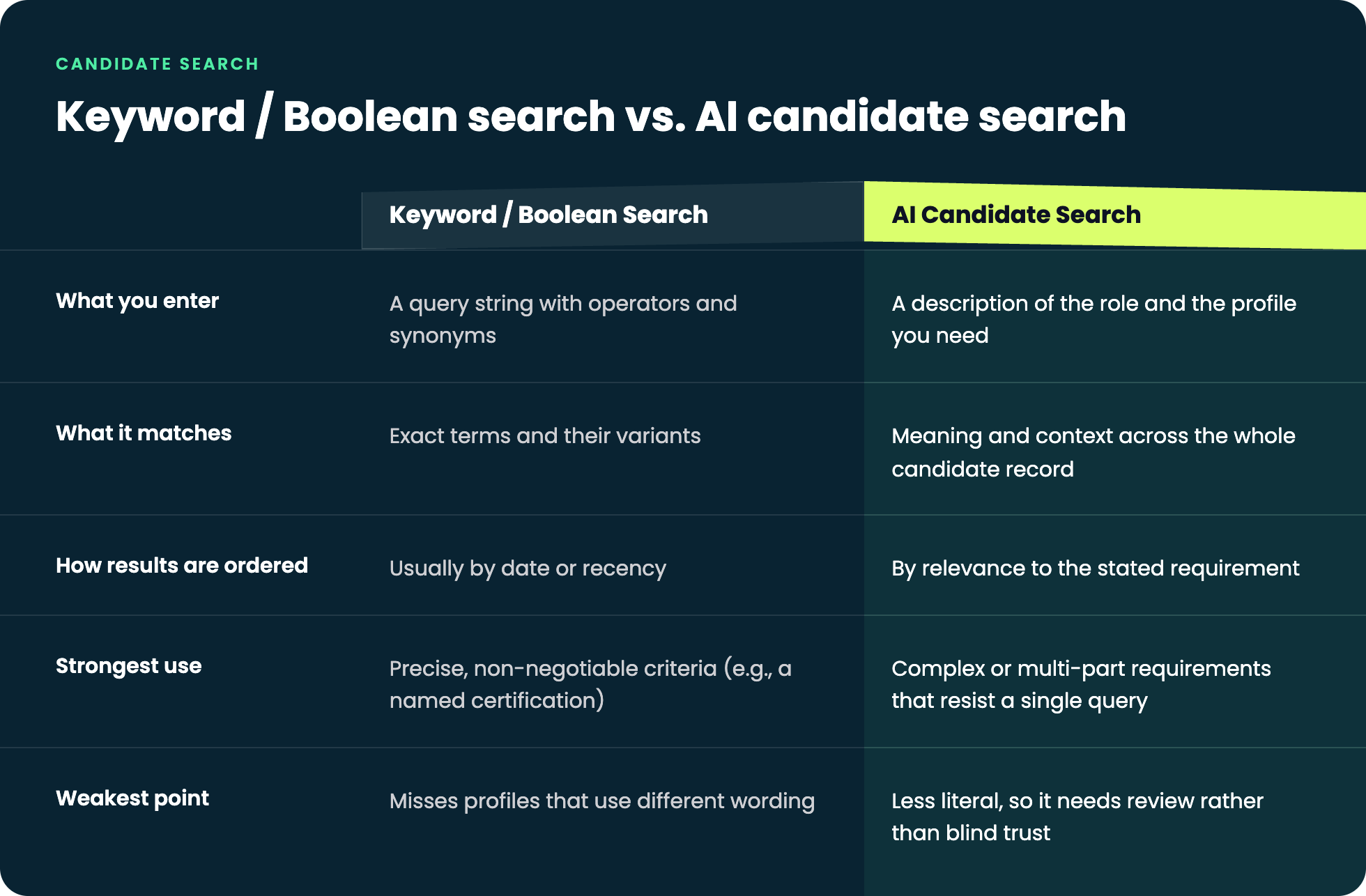
Neither approach makes the other obsolete. Most teams end up using both: AI search to open the field, and precise filters to narrow it once the shape of the shortlist is clear.
How It Works, Step by Step
1. The pool is built
Search quality starts long before anyone types a query. Candidates enter a pool through several routes: an ATS integration that syncs records both ways, an application link placed on a LinkedIn or Kariyer.net posting, an email invitation, a shared invite link, or a manual add. Coensio supports more than 65 local and global ATS integrations, though it can also run effectively without an ATS.
Whatever is not in the pool cannot be found. This is obvious, but it remains the most common reason a search disappoints.
2. The requirement is described
The recruiter writes what they need in ordinary sentences: the role, the seniority, the domain background, the location constraint, and the skills that actually matter. For example: "Product managers with five or more years of experience in Istanbul" or "Frontend developers strong in React and TypeScript with a fintech background".
The point is not that typing is easier. It is that a description can carry several conditions at once—including soft ones like domain familiarity—without collapsing into an unmanageable query string.
3. The description becomes criteria
The system interprets the description as structured requirements: role family, seniority band, required skills, preferred industry, location, and so on. This interpretation step is where semantic search differs from string matching. It is also where ambiguity creeps in, which is why reviewing the criteria the system inferred is a useful habit.
4. Candidates are matched
Matching runs against the candidate's entire record rather than a single field. Coensio's matching analyses past experience, education, skills, seniority level, and other CV details—plus previous assessment scores where the candidate has taken one.
That last input is worth pausing on. In a pool where candidates have completed assessments, the system has evidence of demonstrated skill alongside claimed skill. Most databases do not have this, which is one reason search quality varies so much between organisations that look similar on paper.
5. Results are ranked and explained
Matching candidates are scored and ordered by how closely they fit the stated requirement. TalentRadar generates a short summary for each profile covering the candidate's background and why they surfaced for this particular search.
The explanation matters more than the ranking. A score tells you the order. A summary tells you the reasoning, which is what lets a recruiter disagree with it intelligently.
6. Shortlisting and comparison
From the ranked list, recruiters shortlist and compare candidates side by side, with differences in competencies and experience surfaced in one view. This is the point where the process stops being a search and starts being a decision.
What Actually Determines Result Quality
Five factors determine the quality of your results, roughly in order of impact:
- Pool size and coverage: A search can only rank what exists. A pool of two hundred records for a niche role will produce a thin list regardless of how good the model is.
- Data completeness: Sparse CVs, missing dates, and records that were never parsed properly all degrade matching. Cleaning candidate data is unglamorous work with a direct payoff here.
- How specific the description is: "Senior developer" produces a broad, shallow list. Naming the stack, the domain, and the scope of ownership produces something highly usable. Specificity is the single lever most in the recruiter's control.
- Whether assessment data exists: Pools with prior assessment results give the system concrete evidence rather than relying on self-reported claims alone.
- Role clarity: If the hiring manager has not settled what the role genuinely requires, no search tool can resolve that. It just produces a confident-looking list built on unclear criteria.
Where the Recruiter Still Decides
AI search changes the first twenty minutes of sourcing. It does not change who owns the hire.
The recruiter defines what "fit" means for this role, and that definition drives everything the system does afterwards. The recruiter reads the summary against the reasoning and overrules it when the reasoning is wrong—which happens most often with non-linear careers, career changers, and candidates whose titles undersell their scope. The recruiter knows things the database does not: that the team needs someone comfortable with ambiguity, that the last three hires from a certain background struggled, or that a candidate declined a similar role last quarter.
Practically, a ranked list is a starting order for human review rather than a verdict. The gain is that the same team can work through a far larger pool in the same amount of time, and spend more of that time on conversations instead of scrolling.
Limits Worth Knowing
Semantic interpretation is probabilistic. It infers meaning from context and sometimes infers wrong, particularly for unusual titles, uncommon career paths, or languages where the training signal is thinner.
Consistent criteria applied across a whole database can reduce some of the variation that comes from reviewer fatigue and the order in which CVs happen to be read. It does not make the process entirely neutral. The criteria themselves carry assumptions, and historical data reflects whoever was hired before. Human review and periodic checks on who is surfacing—and who is not—remain a critical part of the job.
Finally, ranking is not evaluation. A high match score means the profile aligns with the description on paper. Whether the candidate can actually do the work is a separate question that assessments and interviews exist to answer.
Where It Fits in the Hiring Workflow
AI candidate search sits at the front of the process, between "we have an open role" and "we have people to talk to." In Coensio, TalentRadar covers that step against the organisation's own pool, while role-specific assessments and AI interviews handle the evidence-gathering that comes after. Search narrows the field; evaluation tests the assumption.
The teams that get the most out of it tend to be the ones with a large accumulated pool and a habit of keeping candidate data usable. If your database is small or mostly stale, the honest answer is that better sourcing channels will move the needle more than better search will.
FAQ
Does AI candidate search replace Boolean search?
No. Boolean remains better for hard, non-negotiable criteria. AI search is better for multi-part requirements and for surfacing profiles whose wording differs from yours. Modern recruitment teams generally use both.
Does it search public profiles such as LinkedIn?
It depends on the tool. Outbound sourcing tools index external profile data. Coensio's AI Candidate Search (TalentRadar) works specifically on the organisation's own candidate database to uncover internal talent, rather than scraping external profiles.
Why did a candidate rank where they did?
TalentRadar produces a summary for each surfaced profile explaining the background and the specific reason it matched the search. That transparent explanation is what makes the ranking reviewable rather than an opaque "black box."
How large does a candidate pool need to be?
There is no universal threshold, as it depends heavily on the role and how specialised it is. However, the general principle holds true: the value of internal AI search grows exponentially with the size and quality of the pool, because that is exactly the point where manual review stops being practical.